When the CEO becomes the best specialist in their own company
“I'll do it faster myself” - I know this sentence all too well. This time it took me all the way to the INFORakademia studio. The result is a webinar about CEOs under pressure, decisions, strategy and a few habits that look like effectiveness up close. From a distance - not necessarily. Come behind the scenes with me.
25 minutes. And far too much to say.
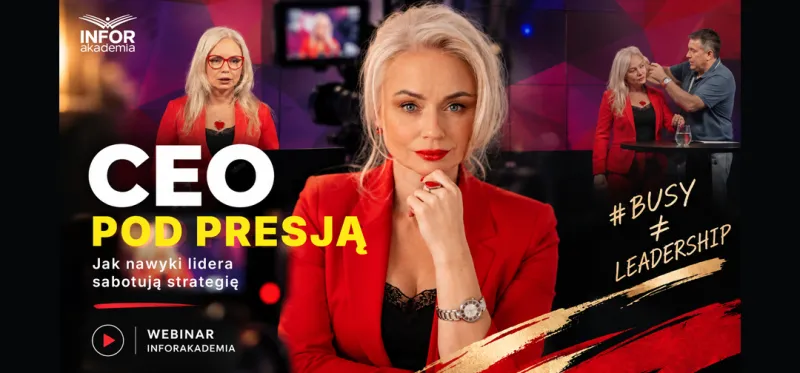
A few minutes before the recording, someone adjusts my microphone. The lights are set. The cameras are in place. On the monitor, I can see myself in a red suit. Next to me, the first slide. We are about to start. And that is when my own, very familiar mechanism kicks in:
Maybe one more example?
Maybe I should add that case?
This slide is important, too…
And, of course, I would love to fit 20 years of experience into them....
but...
I only have 25 minutes.
At some point you have to tell yourself: stop. Choose.
And this is where it got a little funny - Well done, Monika! You came to the studio to tell leaders why they do not have to do everything. And you are trying to change things and add more so you can say everything yourself.
Well. Even an expert sometimes gets hit in the face by their own slide.
The webinar is called “CEO under pressure. How a leader's habits sabotage company strategy” (in Polish).
And perhaps that is exactly why this topic is so close to me. I do not observe it only from the other side of the table. I know this mechanism from the inside, too.
From an idea to the red light in the studio
I do not actually like the moment of recording; I much prefer what happens before. A lot happens. And it is a lot of “fun”. Sheets of paper on the desk. Yes, paper, because I write a lot. By hand ;). The first flow. Crossings-out. A sentence that sounds great but adds nothing. Slide number 38, which really wants to survive, even though everyone knows it should not. And the most important question: What do I really want to say?
With this webinar, I knew one thing from the start. I did not want to make yet another piece about how a CEO has too many meetings, should delegate better and find time for strategy. We leaders know that perfectly well.
I was more interested in why. Why do experienced, intelligent leaders - people who really know how to run a business - start doing things under pressure that do not help them at all in the long run?
And ... why do some of these behaviours even look like a sign of effectiveness?
This question stayed with me throughout the whole preparation process. And two thoughts grew out of it, which I will leave here as well. Only two.
I am saving the rest for the webinar.
No. 1. An effective leader's biggest problem may be what they are really good at
This is a paradox that has fascinated me for a long time. An experienced CEO sees faster. Connects the dots. Knows the business. Recognises risk. Often, they really can make a better decision in five minutes than someone else in an hour.
And then the most innocent sentence in the world appears: “Let me do it.” I know it. I have said it many times myself. Worst of all, I was very often right. It really was faster.
The more I did, however, the more I started to notice something else.
Not only how much time I was saving by taking things over. But also what I was teaching the people around me by doing so.
Because if the leader steps in and solves the problem every time things get difficult, the team very quickly learns who to come back to with that problem next time.
And then “I'll do it faster myself” starts to have a second price. Not in minutes, but in other people's independence.
This is where one of the most important threads of “CEO under pressure” begins. I will not reveal more.
I will leave just one thought:
Sometimes the biggest risk in leadership does not lie in our weaknesses. It lies in the strengths we use too often.
No. 2. Strategy has one fatal problem: it does not shout
The second thing I know all too well is less obvious. In the most intense periods of my work, I never had the problem of having nothing to do. The problem was exactly the opposite. There was always something that needed a decision. Someone was waiting for an answer. Something was not going to plan. A client. A result. The team. The budget. Recruitment. A team meeting. A project that had just veered off course. And each of these things had a very good argument for why it needed attention now.
Strategy usually does not have such an argument. It will not call you in the morning saying “this is urgent, remember me”. It will not squeeze in between two meetings. It will not message you on Teams: “Got a minute? Now.”
Strategy has one fatal flaw: it does not shout.
And that is why you can be really effective all day long. Make decisions, remove obstacles, help people, move things forward. Close your laptop in the evening feeling: I got a lot done today, and at the same time not touch, all day long, the one thing that in six months may matter far more to the company than all of today's “urgent” items put together.
We operate in urgent mode, and that is very treacherous. While it lasts, everything looks fine. There is pace. There are decisions. There is action.
But does movement always mean we are heading in the right direction?
This question has come back to me many times in different roles and organisations. And it came back again while I was preparing this webinar.
Because pressure does not always make us stop acting. We do not just chase the White Rabbit - we become it...
-
↗ SEE ALSO · EXECUTIVE RESET
“We don't have time for strategy right now.”
The White Rabbit, the eternal “not now” and an organisation that runs faster and faster - not always checking whether it is still running in the right direction.
→ Read the Executive Reset “We don't have time for strategy right now.”
-
And then something dangerous slowly happens:
We look less at what will happen in six or twelve months. And more at what needs to be solved by 4 p.m.
In “CEO under pressure”, I do not ask how a leader can fit more into their calendar. I am more interested in what starts to disappear from their field of view once the calendar is already full.
I am leaving the rest of this story for the webinar.
But I would take one thought with me right now:
Urgent things will always find a way to get a leader's attention. Strategy needs the leader to give it that attention themselves.
And then the red light comes on
After all the sheets of paper, the crossings-out, the “one more example” and the slides fighting for their lives, there comes a moment when nothing more can be added. It is the finale - the choice. Done. And a moment later, the red light. The camera. Here we go.
I must admit that this is not my favourite part. I much prefer working my way to an idea than looking straight into the lens. A camera does not give you the energy of a room. I cannot see whether someone has just smiled, frowned or thought: “Oh damn. That is exactly what I do.”
And I really like that reaction.
I like the moment when a good conversation or talk shifts someone's perspective slightly.
In the studio, you have to trust that this will happen on the other side of the screen.
And that is exactly why I value working with Personel i Zarządzanie and INFORakademia. It is another invitation to work together and another opportunity to talk about strategy and leadership not at the level of definitions, but as they really look on Monday morning, when the normal life of a company begins.
Without the perfect CEO.
Without the perfect team.
Without the perfect calendar.
But with decisions, pressure, responsibility and all our “let me do it” moments, which sometimes help more, and sometimes less, than we think.
Ania Włudarczyk - thank you for another invitation, for trusting the topics I bring and for the conversations before the cameras were switched on. And to the whole INFORakademia team - for the professionalism, the calm and all the work on the other side of the lens that you never see afterwards.
And for the fact that after a few minutes you apparently forget about the cameras.
Apparently. 😉
#BUSY ≠ LEADERSHIP
It is here.
25 minutes.
See for yourself.
Definitely fewer slides than I wanted. Only what matters.
Quite a few threads that I deliberately did not tell here.
Because this post was not meant to be a summary of the webinar.
Rather, I wanted to show you part of the road that led to it, and two thoughts that were particularly important to me while I was creating it.
The first:
Being able to do something best and fastest does not yet mean you should do it yourself.
The second:
What fights loudest for your attention does not necessarily deserve it most.
What happens between the first and the second?
That is what “CEO under pressure” is about.
🎥 My new webinar “CEO under pressure. How a leader's habits sabotage company strategy” (in Polish) is available at INFORakademia - watch the webinar.
A leader's advantage does not start with doing more.
It starts with the courage to stop being needed everywhere.
Monika Maria Masztafiak
SEE MORE. CHOOSE LESS. DECIDE BETTER.