SEE BEYOND. CREATE | DEEP DIVE
What do we really design when we design a website?
The anatomy of a project that begins long before the UX and design stage.
When does a company really need a new website?
Many times in my work I have heard a sentence that, at first glance, seems exceptionally concrete:
“We need a new website.”
Over time, however, I have learned that such sentences are not always worth taking literally straight away. Because “we need a new website” can mean very different things. The company may only just be starting out, or it may have grown and no longer fit the communication created a few years earlier - it has changed its client group, expanded its offer, wants to enter a new market. It has excellent competences but can no longer talk about them in a meaningful way. Or it simply looks at its own website and feels that this is no longer us.
At that point, we usually take a logical, intuitive step: find a designer.
On projects like these, however, I increasingly take a step in the opposite direction.
Before we start talking about what the website should look like, I want to understand what has happened in the business to make the current one no longer enough, or what is supposed to happen next and where the company wants to get to.
More than once, this question has changed an entire project. Why?
If we do not first put in order the direction, the offer and who we really want to talk to, a beautiful website design alone will not do it for us. It will only show the same lack of clarity in a new form.
What should a homepage include? It depends on the company's priorities
I remember projects in which the conversation started with the homepage.
“Monika, what should go on the first screen? We think we need to show our most important service. Except that we actually have three most important ones. We also need to say that we work with another client segment. We can't leave out the product we are developing right now. We should mention twenty years of experience. And innovation, of course…” At that point, I usually stop talking about the homepage and …
We start talking about the company's priorities.
Because, quite simply, that is where you have to start. It is one of the reasons why I enjoy working on websites: whatever has been left unsaid in a company comes out very quickly.
In a board presentation, you can have seven equal priorities. On the homepage, you have to decide which of them really comes first, from the point of view of the audience and the business... And that is exactly why a conversation about the homepage so often turns out to be a conversation not about page layout, but about choices the company has not yet made.
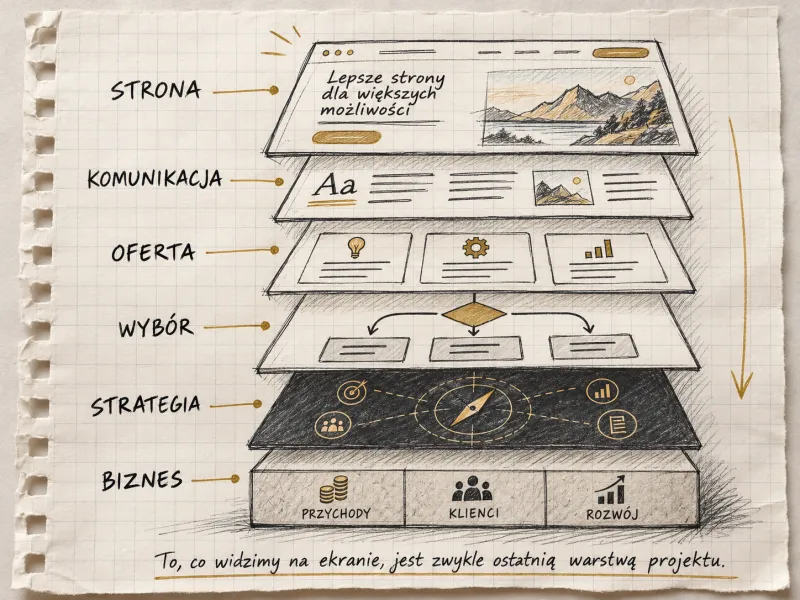
A homepage will not create a company's priorities for us. But it shows very quickly whether we really have them. And what we see on screen is usually the last layer of the project.
Website strategy starts with business decisions
Over time, I began to look at projects like these a little like a cross-section of an organisation.
On the surface I see the website, beneath it the communication, and further down the offer. And beneath the offer, something appears that a designer will not simply design in Figma: a choice.
· Which client really matters to us?
· What do we want to grow on?
· What should be the core of the business, and what an add-on?
· Do we show the company as it has been for the last ten years, or as the company we are trying to build right now?
· Which things will we consciously not communicate?
Yes, these are not questions about the website. But the answers to them will determine almost everything that later ends up on it.
If we do not know who our offer is primarily for, it is hard to decide who the website should speak to. If we do not know what we want to grow on, all services start to look equally important. If we cannot name the value the client should see and understand, we are left with generic slogans about experience, quality, comprehensiveness and innovation. And if we have not decided where the business is heading, a new website very easily becomes an elegant story about the company we were, instead of a tool for the company we want to build.
See more → A good offer doesn't show everything. It helps people choose.
And perhaps that is exactly why website projects interest me so much. We start with a question about the homepage, the menu or the offer, and after a few conversations we are dealing with questions about clients, growth, positioning and the future of the business.
A website does not solve these dilemmas. It reveals them.
Only once the company has made these choices can you really start designing: decide what the client should see first, what they should understand after a few seconds, where we want to lead them and what next step they should take.
A good website does not start with design. It starts with a decision about what kind of company we want to be and for whom.
How did the new AIRIZEN website come about? Business first, then the website
Not every company arrives at its new website by the same route, because not every company has the same problem to solve. Sometimes the starting point is a change in the offer. At other times, it is a new client, entering another market, the need to bring order to the brand, or simply the moment when the business has outgrown its existing way of talking about itself.
I do not start with a ready-made website template. I start by understanding the company that the website will later represent.
The AIRIZEN project showed me this very clearly. When I started working with Ireneusz Bińczak, the company's founder and CEO, the website was not our starting point. First we focused on the business: the market, clients, competition, the offer and the direction in which AIRIZEN wants to keep developing. This part of our collaboration took place in the Strategic Labs format. Only on the basis of these earlier decisions could we move on to the next elements: positioning, image, communication and, finally, the website.
Strategic Labs - see how the work goes from decision to action →
What I particularly valued in this collaboration was Irek's willingness to look at AIRIZEN not only through the lens of today's business, but also of what the company is to become next. In a growing organisation, that matters. A website can very easily turn into an archive of everything the company has done so far. Here we needed something else: communication that would show both real competences and experience and the direction of the company's further development.
In AIRIZEN's case, an additional challenge was the very nature of the business.
This is not a company whose offer can be explained with one product photo and three benefits. AIRIZEN operates in a highly technical environment of industrial projects, around NDT/NDE, welding, quality control, technical support and the provision of certified personnel. Today, the company positions itself as a technical and quality partner for demanding projects in which competence, compliance with standards, accountability and quality of execution are essential.
It is with businesses like this that you can see particularly clearly why I do not believe in a single “proven B2B website layout”.
A website is not a copy-paste template.
A technology company, a law firm, a manufacturer, a premium expert or an organisation like AIRIZEN may need similar elements on their websites. But they should not tell their story according to the same template.
Trust in a brand is built differently when an emotional promise plays a big role, and differently where a client is making a decision about a project in which standards, qualifications, specialists' experience, accountability and execution risk matter.
That is why, at AIRIZEN, the point was not to simplify a technical business so much that it stopped being technical. The point was to organise its complexity so that the right client would quickly understand who they are dealing with, what competences stand behind the company and how AIRIZEN can really help them.
For me, this is one of the fundamental principles of working on websites:
Communication should follow from the logic of the business and the way its clients make decisions, not from a ready-made template.
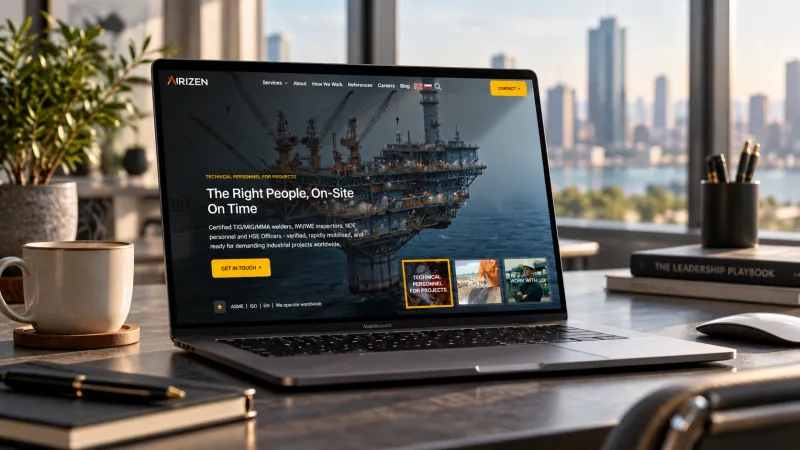
AIRIZEN - strategy, positioning and communication translated into a new website.
See the AIRIZEN website → www.airizen.eu
From strategy to customer experience
Once the business direction, the offer and the positioning have been put in order, the next stage begins: these decisions have to be translated into the customer experience.
And here, design experience alone is not enough. You also need an understanding of UX, the way the audience makes decisions, marketing goals and the role the website is to play in sales and brand building. After all, you can design a very attractive screen that contributes little to the client's decision. You can create a correct information architecture that does not show what the company really wants to grow on. You can even describe the company truthfully, but in a language that is clear mainly to people who have worked there for years. These are common ailments of websites.
I do not treat design as a stage that begins once the strategy is “finished”. Good design organises content, guides attention, builds credibility and helps the audience understand more quickly what matters to them and where they should go next. Experience matters here.
In AIRIZEN's case, this was particularly important. It is a technical business, so the challenge was not to simplify the communication at all costs, but to find the right balance between the specialist nature of the company, the clarity of the offer, expert credibility, UX and the marketing goal of the website. The client should quickly understand who they are dealing with and where AIRIZEN can help them, but without losing the technical depth that is part of this company's value.
This is exactly where strategy becomes visible to the client.
STRATEGY → OFFER → POSITIONING → COMMUNICATION → WEBSITE
Choosing the right website designer
On projects like these, I work on what the company should communicate, to whom, in what hierarchy and to what decision we want to lead the audience. These assumptions then have to be translated well into information architecture, UX, language and the visual layer. That is why I choose partners for specialist work very deliberately. On the AIRIZEN project, I developed the visual layer in collaboration with designer Sebastian N. I value people who are strong in their craft but at the same time understand the business purpose of a project and can look beyond their own part of the work.
Because, ultimately, the client does not experience strategy, copy, UX and design separately.
They experience one company.
And that, for me, is the measure of a coherent project: whether all these elements help them understand the company, trust it and take the next step.
At AIRIZEN, the website was one of the results of a much broader collaboration. Before that, Irek and I had worked together on the company's direction of development, its market, offer, positioning and communication. That is why the way he later summed up our collaboration captures its essence particularly well:
“She helped me look from a broader perspective and put the company's direction of development in order.”
“She can translate business experience into real action.”
Ireneusz Bińczak
Founder & CEO, AIRIZEN
(quotes translated from Polish)
And perhaps it is precisely these two sentences that best show the order I also believe in for website projects.
First you have to see the business more broadly and decide where it is heading. Only then can you translate that direction into specific solutions.
A website is one of them.
A good website responds to a company's specific situation
The AIRIZEN project also shows something else well: I do not believe in one universal way of building company websites.
An organisation entering a new market needs to be presented differently from a company that wants to change its client profile, and differently again from a business that has outgrown its existing offer. A technical company whose value rests on specialist competences and experience, but which has to talk about them in a way the client understands, also requires different decisions. That is why, before we start designing a website, I want to know what business it is to represent, who it is to speak to and what it is to help that business achieve. Only then do decisions about the offer, communication, information architecture, UX and design start to come together into a coherent whole.
That is why, when I hear: “We need a new website.” I do not start by asking what it should look like. First, I want to understand: Why does the company need it right now? Because the answer to that question tells me much more about what kind of website is really worth building for it.
If a similar project is on your table today
Not every company needs the same kind of support from me - and that is a good thing.
If you first need to put the direction, offer, positioning and communication in order, we can work on a project basis, for example in the Strategic Labs format.
If, on the other hand, the change is bigger and you need a partner who will get closer to the organisation, the team and partners and stay on to help translate decisions into action, I also work in the Embedded Leadership (Fractional / Interim / Strategic Advisory) model.
Clarity Before Speed.
#StrategyART · Monika Masztafiak